What to Expect During a Truck Driving Assessment
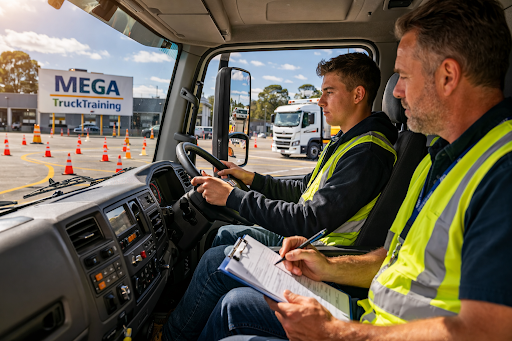
In Australia, truck driving assessments include a vehicle inspection, basic control exercises, and an on-road driving test. You are allowed to operate a heavy vehicle only after passing this assessment.
Truck Driving can be a great career option. As per an official government report, the transport, trucking and freight sector employs around 630,000 to 640,000 Australians. You can also learn real-world truck driving at Mega Truck Training in Perth with personal coaching and DoT-approved assessments.
In this guide, you will learn exactly what happens during a truck driving assessment, what examiners look for, and how you can prepare to pass with confidence.
Before we begin, let’s understand what exactly a truck driving assessment means!
What Is a Truck Driving Assessment?
A truck driving assessment is a practical test conducted to check whether you can safely drive a heavy vehicle. If you pass the assessment, you are allowed to upgrade your licence to drive bigger vehicles.
In Australia, heavy vehicle licences include:
- LR (Light Rigid)
- MR (Medium Rigid)
- HR (Heavy Rigid)
- HC (Heavy Combination)
- MC (Multi Combination)
Each licence allows you to drive different types of trucks. For example, an MR licence allows you to drive rigid trucks over 8 tonnes GVM with two axles. To get these licences, you must usually complete training and pass either:
- A Competency-Based Assessment (CBA), or
- A practical driving test with an examiner.
The examiner makes sure that you understand road safety, heavy vehicle control, and hazard awareness. Then he allows you to drive large trucks on public roads.
Read More: HR Licence Requirements in WA
Requirements Before Taking the Assessment
There are some basic mandatory requirements before the driving assessment. First, you must already hold a Class C car licence. In most cases, you are required to hold it for at least 12 months before applying for an MR licence or 24 months before applying for an HR licence.
You may also need to complete:
- a Heavy Vehicle Knowledge Test
- an eyesight test
- Sometimes a medical assessment is required.
3 Simple Steps to Your Truck Driving Assessment
Step 1 – Pre-Trip Vehicle Inspection
The first step of most truck driving assessments is the pre-trip inspection. The examiner will ask you to check the vehicle before you drive the truck. As a truck driver, you must always make sure your vehicle is safe before starting a trip. During this stage, you need to walk around the truck and explain what you are checking.
If you forget important checks, the assessor may mark you down. So it is important to follow a clear inspection routine every time you drive. So, have a look at them:
External Safety Checks
These checks help ensure that the truck is safe to drive and visible to other road users. A few external safety checks that you may need to inspect are as follows:
- Tyres and wheel condition
- Lights and indicators
- Mirrors and windscreen
- Load security
Mechanical and Safety Systems
Regular vehicle checks are required because heavy vehicles usually travel long distances and carry large loads. So you need to check:
- Air brake pressure
- Fluid leaks under the vehicle
- Warning equipment, such as reflective triangles.
Step 2 – Basic Vehicle Control and Manoeuvres
After the inspection, you move to the vehicle control exercises. This stage checks if you can control the truck properly in tight areas. Heavy vehicles are much larger than cars. Because of that, drivers must show good control and awareness.
Reversing Exercises
Reversing is an important part of driving because trucks need to enter loading docks or tight delivery spaces. During the test, you need to:
- Reverse in a straight line
- Reverse into a parking area
- Reverse around a corner
Gear Control and Hill Starts
You may also demonstrate:
- Smooth gear changes
- Correct clutch control
- Safe Hill starts
Turning and Positioning
The examiner will watch how you:
- Position the truck on turns
- Use mirrors
- Avoid hitting kerbs
If you do it perfectly, it will prove that you understand vehicle size, blind spots, and turning radius. And you are ready for the next step, which is real road driving.
Step 3 – The On-Road Driving Test
The final and most important part of the assessment is the on-road driving test.
Here, you will drive the truck on public roads while the examiner observes your driving skills. The route usually includes different traffic situations so they can see how you react.
Driving in Real Traffic
The examiner wants to see if you can follow road rules and stay calm in normal traffic. You drive through:
- Busy streets
- Intersections and traffic lights
- Roundabouts
- Multi-lane roads
Hazard Awareness
Trucks take longer to stop than cars, so it is important for you to have a good understanding of hazard awareness. During the test, the assessor watches how you:
- Keep safe following distances
- Notice hazards early
- Slow down when needed
Mirror and Blind Spot Checks
Truck drivers rely heavily on mirrors. The examiner will look for frequent mirror checks, especially when you take a turn, change lanes or merge into traffic.
Click here to see current truck driving training prices
Skills You Need to Impress the Assessor
During the assessment, the examiner is not expecting perfection. Instead, they see how safe you can drive.
Safety Awareness
You must show that you understand how to drive safely around other vehicles. This includes:
- Keeping safe distances
- Scanning the road ahead
- Following speed limits
Vehicle Control
The examiner checks whether you can control the truck smoothly. This means:
- Steady steering
- Gentle braking
- Controlled gear changes
Decision Making
Good truck drivers make smart decisions quickly. For example, you should know when to slow down, change lanes safely, or stop if something looks dangerous.
Common Mistakes That Cause Drivers to Fail
Just imagine that you are reversing a truck. You feel stressed and forget to check your mirrors. The truck moves and by the end touches a wall. And that simple mistake failed your test.
Many learners fail their assessment because of small but important mistakes. Sometimes drivers also fail because they become nervous and rush their actions. So, you must avoid these common problems:
- Forgetting mirror checks
- Turning too tightly
- Unsafe lane changes
- Missing road signs
- Poor reversing control
Tips to Prepare for a Truck Driving Assessment
Remember, most drivers pass the assessment after proper training and practice. Here are a few helpful tips:
- Practice reversing and manoeuvring as much as possible. These are common test tasks.
- Study the heavy vehicle driver handbook. It explains rules about:
- Speed limits
- Load restraint
- Fatigue management
- Safe braking distance.
- Practise driving in real traffic with an instructor. This helps you get used to busy roads, intersections, and roundabouts.
- Finally, try to stay relaxed on test day. Being calm helps you think clearly and avoid mistakes.
Kick Off the Training from a Registered Training Organisation
Passing this assessment is the first step toward a long career in the transport industry. With practice, proper training, and a calm mindset, you can pass the test and start driving larger vehicles legally in Australia.
Always take lessons with a Registered Training Organisation (RTO) to prepare for the practical test. Mega Truck Training (RTO #53025) is one of Perth’s Registered Training Organisations. You can get practical training from us.
FAQs
How long does a truck driving assessment take?
It will take between 45 minutes and 90 minutes, depending on the licence class.
Can you fail the truck driving test in WA?
Yes. Common reasons include unsafe lane changes, poor reversing control, and missing mirror checks.
Do you need training before the test?
Yes. Most drivers take training through an RTO before attempting the assessment.